

AI for HR and Finance Teams: Less Repeat Work, Fewer Errors
Short answer: AI for HR and finance teams works best when it handles drafting, summarising and documentation, while people keep decisions, figures and personal data under human control. Start with internal documents and synthetic examples, check every number and name against source records, and keep staff and client data out of unapproved tools.
Why HR and finance feel the pressure first
AI for HR and finance starts with repeatable documents: job ads, offer letters, policy drafts, onboarding packs, monthly reports, variance notes and procedure manuals. The writing is steady, the formats repeat, and the backlog grows. That is exactly the profile where AI assistance pays off.
These two functions also hold the most sensitive information in the company. Salaries, medical notes, bank details and identity documents all pass through them. So the same teams that can save the most time also carry the most risk if habits are sloppy.
Where AI for HR teams helps most
- Drafting job ads and role descriptions. Give the tool the role, level and must-haves, and it produces a structured draft. You check for bias in wording and accuracy of requirements before posting.
- Policy and handbook drafts. AI produces a workable first version from your bullet points. HR still verifies it against current Malaysian employment requirements and company practice, ideally with legal review for anything binding.
- Onboarding material. Turn existing process notes into welcome guides, checklists and FAQ documents for new hires.
- Summarising applications with care. AI can help compare CVs against criteria, but shortlisting decisions belong to people. Automated screening can repeat and amplify bias, and candidates deserve human judgment on decisions that affect them.

Where AI helps finance teams
- Turning numbers into narrative. Paste approved, non-sensitive figures and ask for a plain-language variance explanation, then verify every number against the actual report.
- Procedure documentation. Convert the way your team actually closes the month into written SOPs and checklists.
- Drafting internal communications. Budget reminders, expense policy updates and audit requests in clear language.
- Learning and comparison. Explaining an unfamiliar tax term or comparing two accounting treatments at a general level, always confirmed against official sources or your accountant.
The rule that protects both teams: check every number and name
AI writes confidently even when it is wrong. It can misstate a figure, invent a reference or merge two employees into one. For HR and finance output, adopt a fixed habit: every name, figure, date and clause is checked against the source document before the output is used. No exceptions, including drafts labelled internal.
Evaluation is a skill on its own. A practical habit is to score AI output against three questions: is it accurate, is it complete for the purpose, and would you sign it. If any answer is no, it goes back for human work.
Data safety for HR and finance
The habits in our safe AI use guide apply doubly here:
- Use only AI workspaces and accounts your company has approved. A paid plan on its own does not make a tool safe.
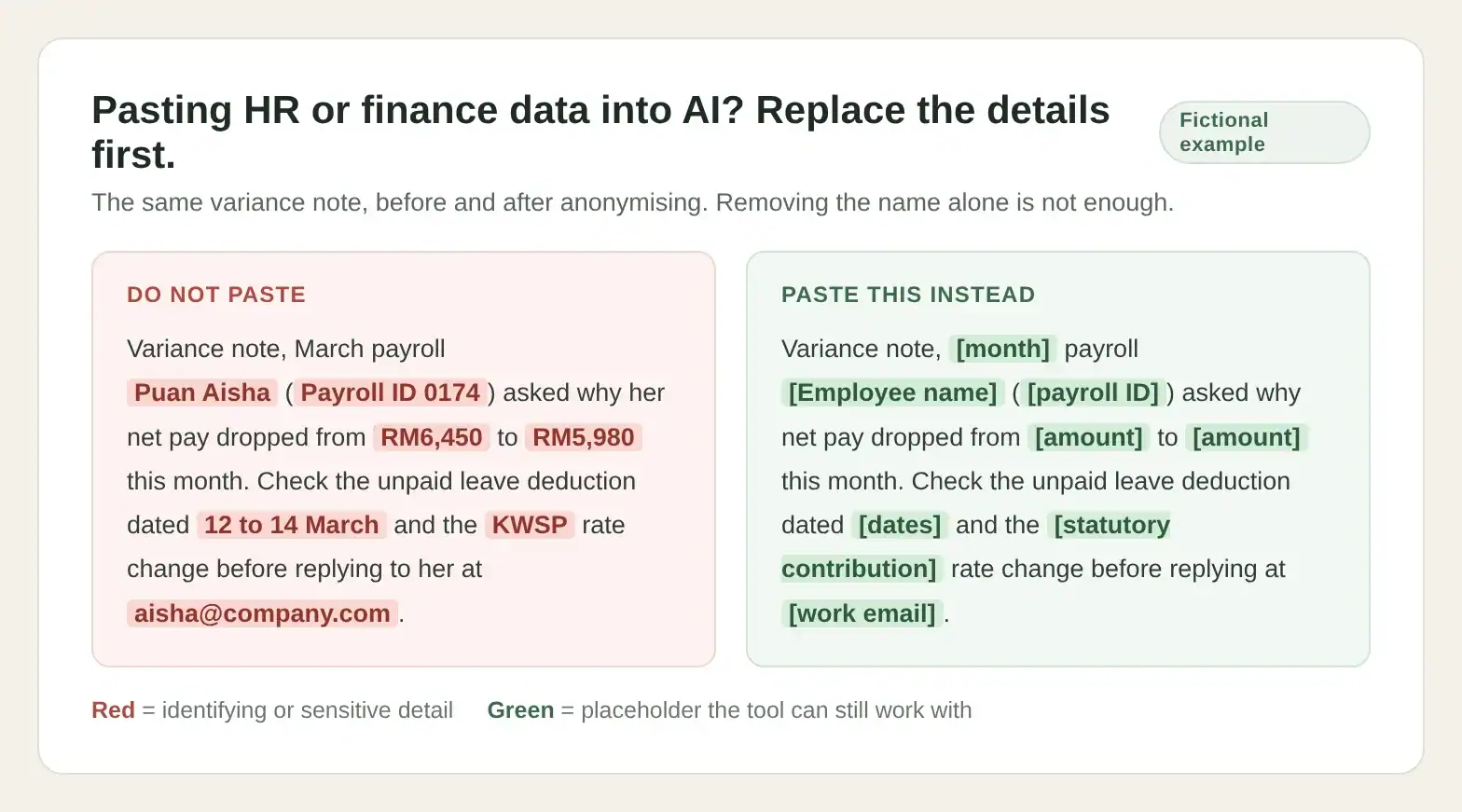
- Removing names from a document is not enough. Salaries, bank details and combinations of small facts can identify a person even without a name attached.
- Work with synthetic or anonymised examples when practising, never real staff or client records.
- If something sensitive is shared by mistake, stop sharing immediately, notify your security or privacy contact, and preserve the details of what was shared. Delete anything only on the instruction of the team authorised to handle it.
Malaysia's Personal Data Protection Act may apply to much of this data, and amendments have raised the stakes. This article is general information, not legal advice; check your obligations with your privacy officer or legal adviser.

Rolling AI out in a small HR or finance team
A workable starting sequence for most SMEs:
- Pick one document type, for example job ads or monthly variance notes.
- Agree what may and may not go into a prompt, in writing.
- Practise for two weeks on synthetic or historical material.
- Review output quality together weekly: accuracy, completeness, time saved.
- Expand only when the habit is consistent.
Common mistakes to avoid
The patterns that cause trouble with AI for HR and finance are the same across companies:
- Trusting fluent output. A well-written paragraph about your EPF or SOCSO obligations can still be wrong. Fluency is not accuracy.
- Pasting real records "just this once". One salary spreadsheet in an unapproved tool is a privacy incident, not a shortcut. If it happens, follow the incident steps above rather than quietly deleting the chat.
- Skipping the review because the first result looked good. The check takes minutes. The cleanup after a wrong figure reaches a client takes much longer.
- Letting each person experiment privately. Unguided use produces inconsistent quality and invisible risk. A short shared guide and one approved workspace beat ten private experiments.
What good looks like after three months
Rolled out steadily, AI for HR and finance teams shows a predictable picture: routine drafting time drops, documents become more consistent, and the review habit spreads to non-AI work. The gains come from the habits, not the tool brand. That is why effective training focuses on evaluation and workflow rather than button-clicking: tools change every few months, but the ability to judge output stays valuable.
Which tasks to hand over first
The safest first tasks for AI for HR and finance share three traits: the source material is not confidential, the output is checked anyway, and a mistake is cheap to catch. For HR that is job ad drafts and onboarding checklists. For finance that is SOP documentation and first-draft variance notes on non-sensitive figures. The risky end of the scale, anything touching personal data, payroll or client money, stays manual until the company has an approved workspace and a written rule. This ordering is deliberate: early wins build the checking habit before the stakes rise.
Measuring whether it is working
Judge AI adoption by outcomes, not activity. Three measures cover most of it: turnaround time for the chosen document type, error rate found in review, and whether staff still verify numbers as carefully as before. If the third slips, the first two do not count. Review monthly for the first quarter, and be willing to stop a use case that looks fast but keeps producing subtle errors. Speed that exports mistakes to clients or regulators is not a saving.
Frequently asked questions
Can AI replace our HR or finance staff? In practice, it removes drafting and formatting time. Judgment, verification and accountability stay with the team, and those are the parts that protect the company.
Is it safe to paste a spreadsheet into an AI tool? Only if the workspace is company-approved and the sheet contains nothing confidential or personal. When in doubt, describe the structure and use sample rows.
What about AI features inside our accounting or HR software? Features built into software your company already controls keep data inside a system you govern, a safer start than a separate chat tool. Your vendor's terms still need a read.
The bottom line
AI for HR and finance teams pays off when the split is clear: machines draft and summarise, people verify and decide. Protect the personal data you hold, check every figure, and expand one document type at a time.
Want your HR or finance team trained on practical, safe AI workflows? Mike runs HRDC claimable corporate sessions on AI for workplace productivity across Malaysia.


