

AI Note Taking in Malaysia: From Discussion to Minutes
Short answer: AI note taking turns meeting recordings into transcripts, summaries and action lists, which can return meaningful time to your team. The value is real, but so are the risks: get consent before recording, use company-approved tools, and treat every summary as a draft until someone checks names, decisions and numbers against what was actually said.
Why meetings eat so much time
The meeting is only half the work. Someone writes notes, types them up, chases action items and answers "what did we decide?" for weeks afterwards. In many Malaysian SMEs this falls on whoever is least busy, which means notes vary wildly in quality.
AI note taking attacks exactly this problem: the recording is transcribed, the key points are summarised, and action items are listed with owners. Done well, minutes go out the same day instead of next week.
What AI note taking can do today
A typical tool covers some or all of these four jobs:
- Transcription. Speech becomes text, usually with speaker labels. Accuracy varies by tool and language; expect more errors with mixed Bahasa Melayu and English, accents, or crosstalk.
- Summaries. The main topics, decisions and open questions in a few paragraphs.
- Action lists. Extracted tasks, sometimes with owners and deadlines.
- Search. Ask later what was said about a topic without re-listening.
Dedicated meeting tools do this inside your call platform, and general AI assistants can summarise a transcript you provide. Either way, the output is a draft, not the minutes.

What to check before trusting the notes
AI summaries fail in predictable ways. Before notes go out, the meeting owner should verify:
- Decisions versus discussion. Tools often present an explored idea as an agreed decision. The minutes must separate the two.
- Names and owners. Speaker labels are frequently wrong, so action items get attached to the wrong person.
- Numbers and dates. Figures in summaries are paraphrased and sometimes transposed. Check them against the transcript.
- What was left out. A short summary drops nuance. If a caveat mattered in the room, make sure it survives in the notes.
A useful habit: the owner edits the AI draft within a day, while memory is fresh, and marks it as reviewed before circulating.
Consent and privacy come first
Recording people raises real obligations. Practical ground rules:
- Tell participants the meeting is being recorded and transcribed, and give them the chance to object. Many jurisdictions and company policies require this, and it is good manners everywhere.
- Use tools and accounts your company has approved, so recordings and transcripts stay under company control. A paid plan alone does not make a tool safe. Our safe AI use guide covers what should never go into an AI tool.
- Be careful with client calls: confirm the client is comfortable being recorded, and check what the tool vendor does with the audio.
- Malaysia's Personal Data Protection Act may apply to recordings and transcripts. This is general information, not legal advice; confirm with your privacy officer or legal adviser.
- If something sensitive is captured or shared by mistake, stop sharing, notify your security or privacy contact, and preserve the details. Delete recordings or transcripts only on the instruction of the team authorised to handle it.
From notes to action: making summaries useful
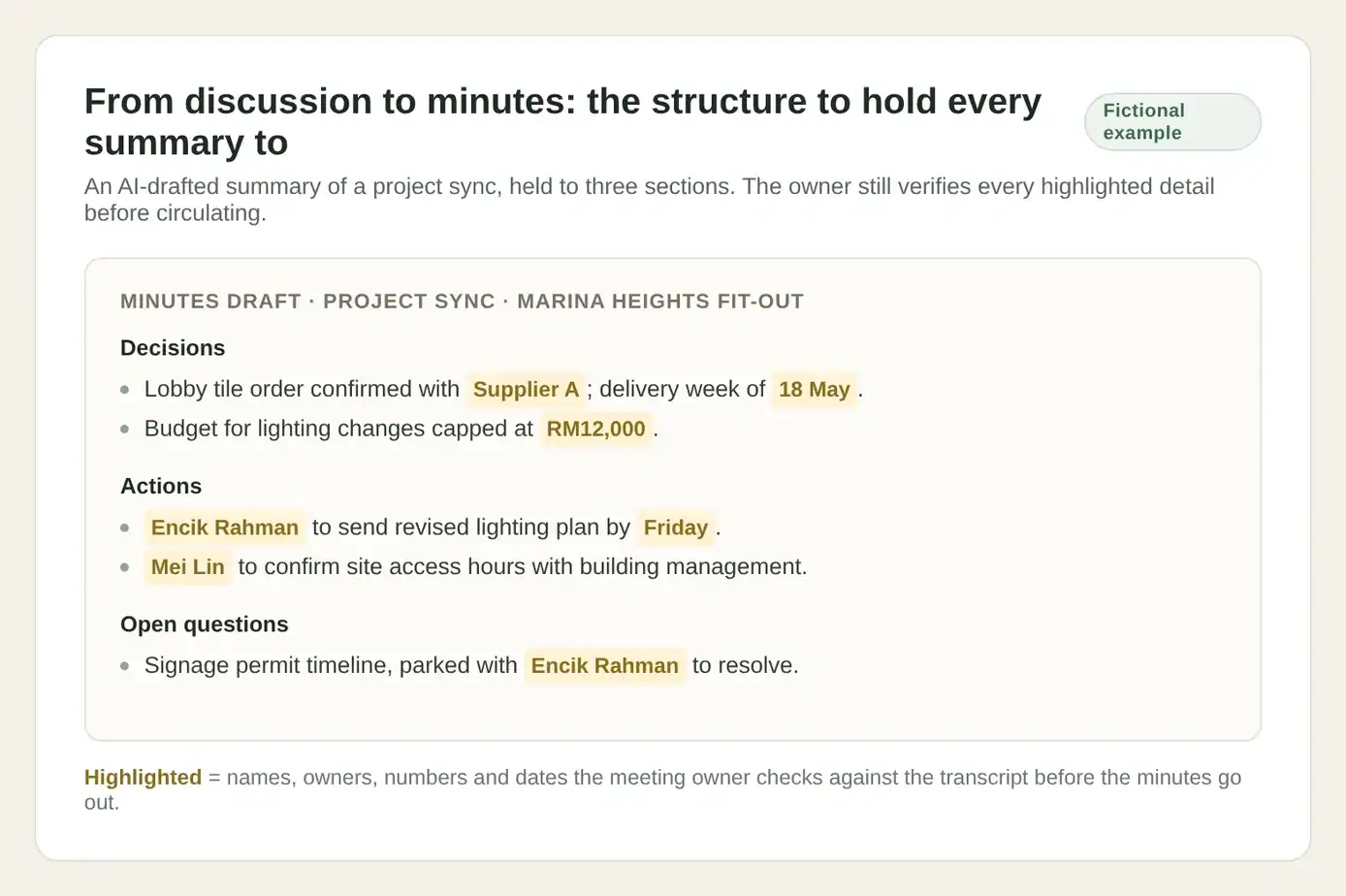
The meeting that produces no follow-through wasted everyone's time, with or without AI. A short structure makes AI output useful:
- Decisions, each in one sentence, with the decider named.
- Actions, each with one owner and a date.
- Open questions, parked with a named person to resolve them.
Whether a tool drafts it or a person writes it, hold the minutes to this structure. Over a month, this habit can also shorten meetings, because people know decisions will be written down.
Where AI notes do not belong
Some meetings should stay off the record entirely: disciplinary conversations, medical or personal discussions, legal strategy, and anything your company policy marks as restricted. No productivity gain justifies recording those. When in doubt, take human notes or none.
Choosing a tool: what to evaluate
AI note taking tools change names and features quickly, so evaluate on outcomes rather than feature lists:
- Transcript accuracy on your real meetings, including mixed language and your industry's terms. Run a two-week pilot and measure corrections needed.
- Data handling. Where recordings and transcripts are stored, who can access them, and whether the vendor uses your content for other purposes. Your IT or privacy contact should read the terms before company-wide use.
- Admin controls. Can your company manage users, retention and deletion centrally? Individual sign-ups create shadow copies you cannot govern.
- Fit with your call platform. Friction kills adoption; if joining and sharing is awkward, people stop using it.
Rolling out without friction
Start with one recurring internal meeting, for example the weekly team sync. Appoint the meeting owner as the reviewer of the AI draft. After a month, ask two questions: did notes go out faster, and did follow-through improve? If yes, extend to more meetings. If the tool created more correction work than it saved, change the setup before scaling. The habit matters more than the brand: a modest tool with a disciplined reviewer beats a premium tool nobody checks.
A weekly review habit that keeps notes honest
Even good AI note taking setups drift. A five-minute weekly check keeps the system trustworthy: pick one meeting at random, compare the AI summary against the transcript, and count the corrections. If corrections climb, retrain the team on reviewing rather than abandoning the tool, because the common cause is reviewers skimming. Also confirm recordings are being announced out loud, not only mentioned in a calendar footnote nobody reads. Habits decay quietly; the audit is what keeps consent and accuracy real rather than assumed.

Working across English and Bahasa Melayu
Mixed-language meetings are the norm in Malaysia, and this is where transcription earns its keep and its caution. Expect lower accuracy on mixed-language speech, and speaker-label confusion when people code-switch inside one sentence. For bilingual meetings, assign the review to someone who was in the room and speaks both languages comfortably. If a meeting will be mostly in Malay, say so when testing tools during a pilot, because marketing demos rarely show that case.
Frequently asked questions
Does AI note taking work in Bahasa Melayu? Transcription quality varies by tool and language, so test with your own meetings before rolling out.
Can AI join meetings on our behalf? Some tools offer a bot attendee. Treat that like any recording: inform participants, and think carefully before sending a bot into a client call.
Are AI minutes acceptable for formal records? For board or formal minutes, the company secretary or chair must verify and approve them. AI drafts are a starting point, not the record itself.
The bottom line
AI note taking can be a clear productivity win for office teams, as long as consent, approval and a quick human review are built into the habit. Record openly, verify decisions and owners, and let the machine handle the typing.
Want your team trained on practical AI workflows like meeting notes? Mike runs HRDC claimable corporate sessions on AI for workplace productivity across Malaysia.


