
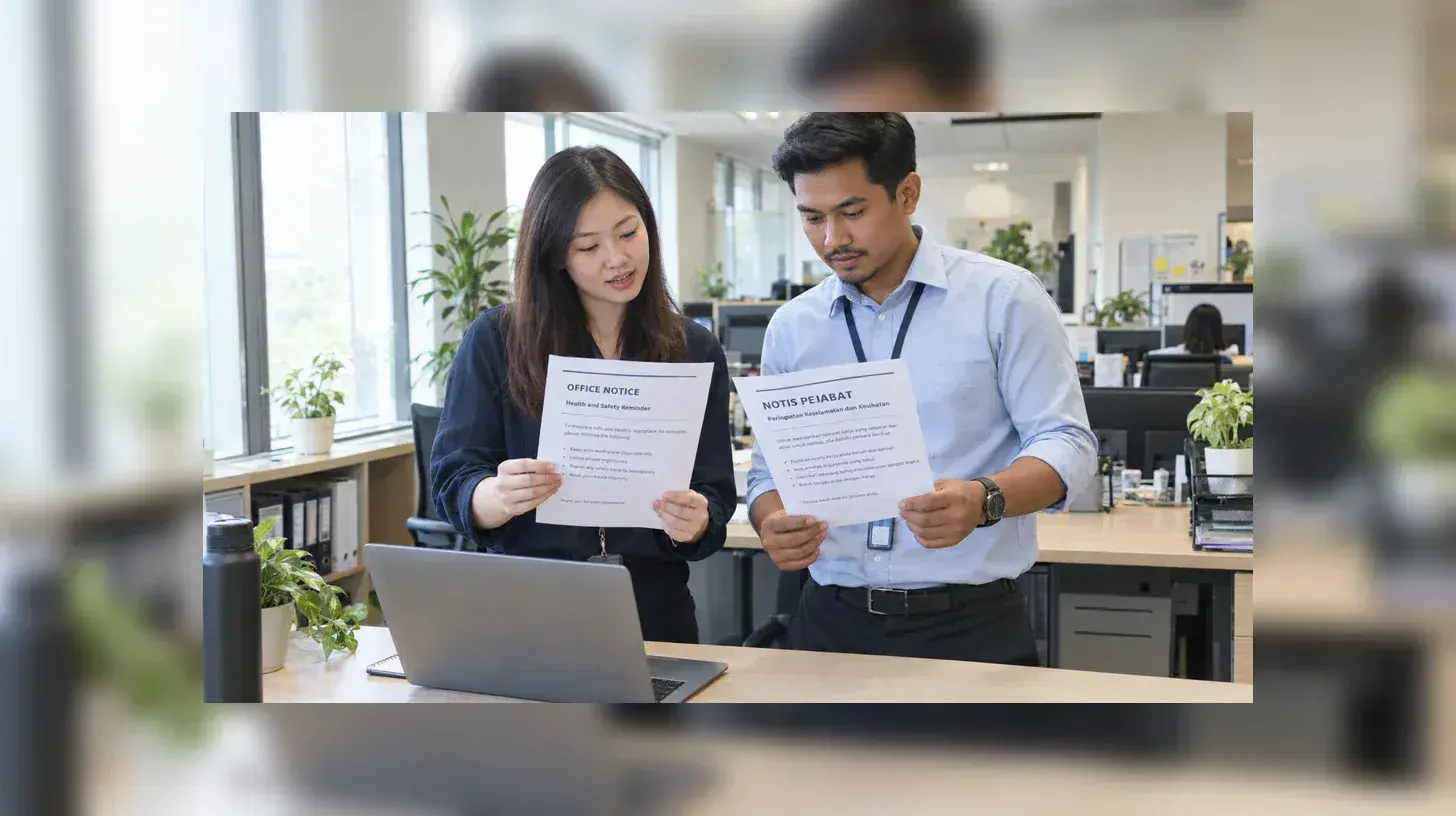
AI for bilingual workplaces: drafting in English and Bahasa
Short answer: AI translation BM English handles the routine layer of bilingual office drafting well, but it still stumbles on register, code-switching and sensitive content. The time saved is real, while the judgment calls stay with people. Every language your company writes in still needs a bilingual reader who owns it.
Most Malaysian offices run on two languages at once. The morning briefing happens in English, the WhatsApp group replies in Bahasa Malaysia, and the same announcement often has to exist in both before lunch.
AI has slid into that workflow quietly. A staff member drafts in one language, asks the tool for the other, and sends both versions out. The search interest around AI translation BM English keeps growing because the need is daily and ordinary.
The tool is genuinely useful here.
It is also genuinely uneven, and the uneven parts are exactly the parts readers notice most.
Where the tool already pulls its weight
First drafts across the language divide are the clearest win. An HR notice written in English can appear in serviceable Bahasa Malaysia within seconds, ready for a person to correct rather than compose from zero.
Consistency is the second win. When the same policy has to exist in two languages, a tool that carries the structure across both versions reduces the slow drift where the English copy says one thing and the Malay copy says something softer.
Speed matters most for the unglamorous middle layer of office writing. Meeting recaps, internal circulars, event reminders and FAQ updates are exactly the documents that used to wait days for a willing translator.
Anyone comparing options will find that AI translation BM English handles this layer comfortably, and the time saved is real and measurable.

Where the second language quietly goes wrong
Register is the first casualty.
Bahasa Malaysia has levels of formality that do not map neatly onto English, and a tool trained on averages tends to pick one register and stay there, whatever the audience.
A circular to staff can come out sounding like a legal filing. A letter to a government agency can come out sounding like a newsletter. The words are correct in both cases, and the letter is still wrong.
Official terms are the second casualty. Malaysian workplaces use specific terms for leave types, statutory bodies, allowances and procedures, and the official Malay term is often not the literal one the tool produces.
Anyone who has received a notice about “cuti tahunan dibawa ke hadapan” rendered in some inventive new phrasing knows the feeling. The reader now has to decode the document before they can act on it.
The code-switching problem
Real Malaysian office writing is not two pure languages.
It is a continuum, and the middle of that continuum is where a great deal of actual communication lives.
A manager writes to her team in English with Malay warmth woven through it. A technician files a report in Malay with English technical terms left untouched, because translating “torque wrench” would confuse everyone who uses one.
Tools handle the two pure ends far better than the mixed middle. Ask for a translation of a code-switched message and the output often flattens everything into one language, losing the choices the writer made on purpose.
The practical consequence is that AI translation BM English works best on documents that are already formal and single-language, and needs the most supervision on the casual messages that carry the most relationship weight.
Judgment calls that stay with people
Deciding which language leads is a human call. Some announcements should be conceived in Bahasa Malaysia because the audience thinks in it, and translating an English-first draft backwards produces prose that smells faintly imported.
Deciding what must not be translated is another. Names, official designations, slogans and certain technical terms should stay fixed, and a person has to tell the tool that every single time.
Deciding who reads the final version matters most of all. A bilingual reader must sign off on bilingual output, because the monolingual manager approving the English half has no way to know what the Malay half actually says.
These calls are not flaws in the technology.
They are the shape of bilingual work, and they existed long before the tools did.
Why the second language gets judged harder
Readers forgive a clumsy sentence in a language they think in, because they hear the intention behind it. The same clumsiness in a translation reads as carelessness, because the reader can tell nobody checked. The draft may be machine-made, but the judgment about it lands on the company.
In Malaysian offices this lands on the Bahasa Malaysia half most often. A notice that sings in English and limps in Malay tells a large share of the workforce exactly where they rank in the writer’s attention.
That is why the bilingual reader is not a luxury on top of the process.
The reader is the process, and AI translation BM English only reaches the standard when that person is in the chain.
Mistakes that keep repeating
Sending the translation without a reader. The draft looks complete, so it goes out, and the first bilingual person to read it becomes the unpaid proofreader.
Treating both versions as equally authoritative. When the two copies disagree, one of them has to win, and someone should have decided which before anyone asked.
Feeding sensitive text into whatever tab is open. A translation task feels harmless, but the content is still company information leaving the building.
Letting the tool set the tone of the second language. The English original sounds like your company because a person tuned it. The translated half sounds like the average of the internet until a person tunes it too.
None of these problems are reasons to avoid AI translation BM English, and none require new software to fix. They require the same habit bilingual offices have always needed: a named reader for every language that goes out the door.

What good looks like in practice
Imagine a property management office sending a lift-maintenance notice to residents. The English draft takes ten minutes, the tool produces the Bahasa Malaysia version in seconds, and a bilingual colleague spends five minutes fixing register and terms.
Both versions go out together, and residents read whichever language they prefer without hitting a strange phrase.
Total time is under half an hour for what used to take a day of waiting.
That is the honest promise of AI translation BM English in a working office. The tool compresses the slowest stretch of the road, and a person still drives the last mile.
FAQ
Is AI translation BM English accurate enough for official letters?
Accurate enough to draft, rarely accurate enough to send unread. Official letters carry fixed terms and registers that tools still fumble, and the cost of a wrong phrase in an official context is higher than the minutes saved. A bilingual reader should always make the final pass.
Should we draft in English or Bahasa Malaysia first?
Draft in the language your primary audience thinks in. If most readers will read the Malay version, writing it first keeps the thinking natural, and the English translation tends to travel better in that direction than the reverse.
Can the tool handle Manglish or mixed-language messages?
It handles them unevenly, usually by forcing everything into one tidy language. For internal chat that is often fine. For anything a customer or supplier reads, keep the mixing deliberate and have a person decide which parts switch and which parts stay.
Does it matter which AI tool we use for bilingual drafting?
Less than people expect. The gap between tools is smaller than the gap between having a bilingual reader and not having one, so fix the reading step before shopping for a better engine. For AI translation BM English in particular, the reading habit beats the engine choice every time.
Who should own the Bahasa Malaysia version if nobody on the team is confident?
Someone still has to own it, because an unowned translation is an unread one. Pick the person whose Malay is strongest, give that person the final say, and treat the reading time as part of the document’s real cost.
How do we keep both versions consistent over time?
Keep a small shared list of fixed terms, covering official names, leave types, departments and common phrases, with the agreed wording in both languages. Paste the relevant lines into every translation request, and the tool’s output stays much closer to your house style. When the Malay wording is in dispute, the official Dewan Bahasa dan Pustaka dictionary settles it faster than another round of opinions.
Two languages, one standard
Bilingual drafting is where AI fits Malaysian offices most naturally, because the volume of two-language writing here is enormous and mostly routine. The tools behind AI translation BM English will keep improving, and the drafts will keep getting closer to sendable. What does not shrink is the cost of sending the wrong tone to half your audience.
The standard does not move, though. Every language your company writes in deserves a reader who owns it, and that was true before the tools arrived and will stay true after the next upgrade. Teams that accept this stop arguing about which engine to buy and start getting both halves right.
Mike Cheong helps Malaysian teams put AI to work on real bilingual drafting, from circulars and notices to customer replies, through hands-on training built on the documents your office actually sends. To talk about training for your team, message Mike Cheong on WhatsApp.


