
AI Training vs Self-Learning: When a Course Pays for Itself
Short answer: It depends on what the team needs: self-learning suits individual curiosity and single-tool skills. A course tends to earn its fee when a whole team must change how it works, when mistakes carry real cost, or when time matters more than money, and the team has the practice and support to reinforce it afterwards.
Every Malaysian manager weighing AI upskilling faces the same question.
Why pay for training when the internet is full of free tutorials?
It is a fair question.
The answer starts with what self-learning is genuinely good at.
The case for self-learning
- It is nearly free. Official tutorials, documentation and community videos cover every major AI tool. Even Malaysia's National AI Office runs public AI awareness programmes.
- It moves at your pace. A motivated person can pause, rewind and practise at midnight.
- It is good for tool fluency. Learning where the buttons are and what a tool can do is exactly what free content does best.
- It suits the solo learner. One curious staff member exploring AI for their own tasks is a low-risk use of free material.
- Feedback exists outside classrooms too. Peer review, manager input and online communities can all supply correction. Some independent learners build excellent feedback loops entirely on their own.
For one person, low stakes and plenty of time, self-learning is often the right answer.
The risks appear when a company expects it to carry a whole team.

Where self-learning can quietly stall
- Feedback may be missing. Many solo learners have no one reviewing their output.
- The numbers agree.In KPMG's 2025 study, 58% of U.S. workers admitted relying on AI output without properly evaluating it, and 57% said that reliance had led to mistakes in their work.
- The team can end up with ten private workflows. When everyone learns alone, everyone prompts, checks and shares differently. There may be no shared standard to hand a new hire.
- Free content rarely reviews your actual work. A tutorial can show what a tool does. It usually cannot look at your tender document and say where it goes wrong, though a strong community or mentor sometimes can.
- Motivation often fades without structure. Not for everyone: disciplined self-learners finish what they start. Many half-finished course tabs stay half-finished once daily work piles up.
None of this is a character flaw, and none of it applies to every self-learner.
It is what tends to happen when a team-level change is left entirely to individual effort.
What training changes in practice
Imagine a junior executive asking an AI tool: "Write a proposal email for our logistics service to a manufacturing client in Penang."
The draft comes back in seconds. Smooth, confident, professional.
It also invents a delivery statistic, guesses the wrong industry pain point, and promises a turnaround the operations team cannot meet.
A reader new to AI tools sees a good email and sends it.
A practiced reviewer, self-taught or course-trained, pauses at three places: the statistic, the pain point and the promise.
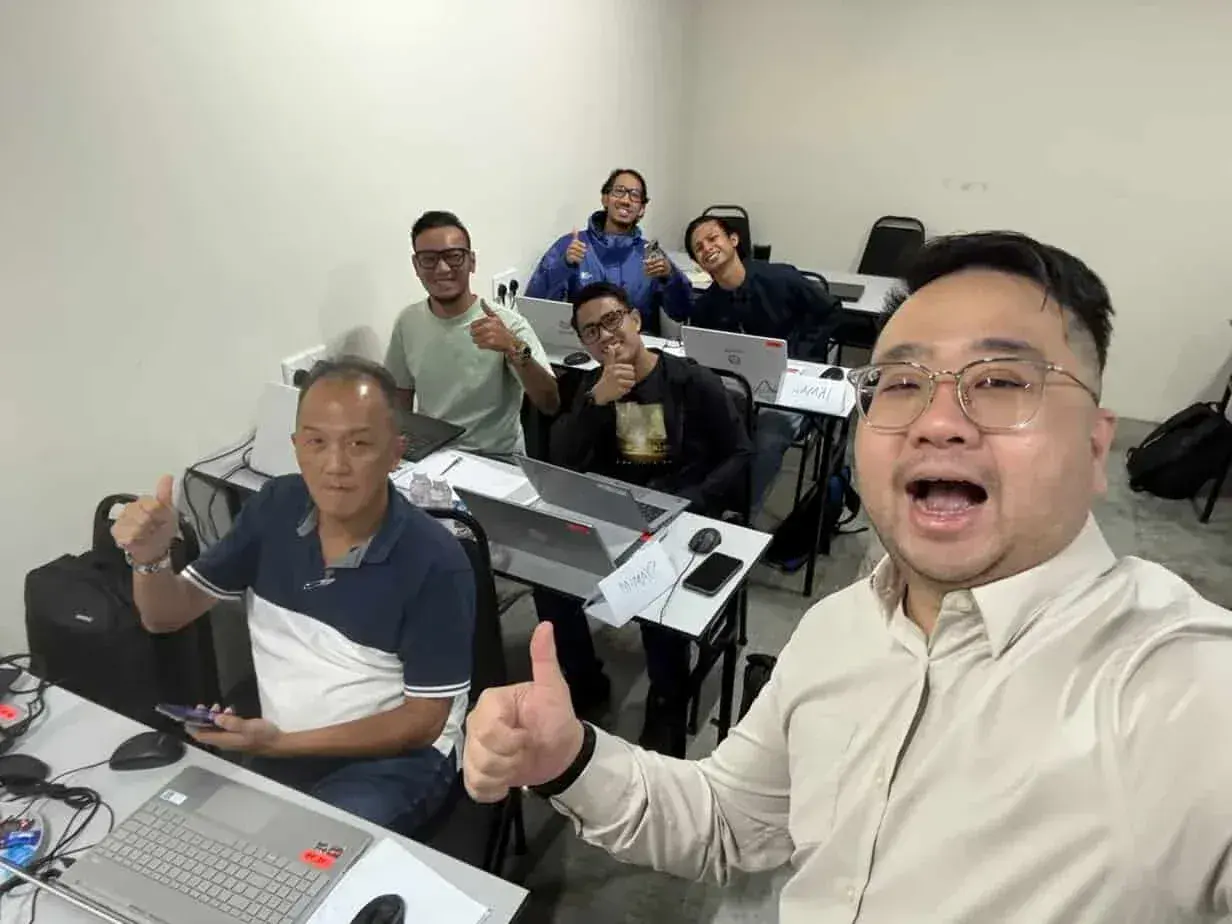
In a good training room, the trainer asks the learner to find the invented figure and the unworkable promise before the email leaves, and the correction lands while it still costs nothing.
The gap between those two reactions is not information. It is practice with feedback, and a good course is one way to get it.
What a good course can buy
Information is free, so a course that only delivers information is hard to justify.
A good one offers something else.
- A shared vocabulary. After training together, a team is far more likely to mean the same thing by "check the source" or "safe to paste". That shared language is what makes ground rules workable.
- Feedback on your real work. A good trainer can spot quickly what a learner working alone may take much longer to notice: the weak prompt, the unchecked figure, the confidential detail about to be pasted.
- Compressed time, when the course is well run. Guided practice on the tasks the team actually does can fold weeks of individual trial and error into days. Not every course achieves this.
- A better chance of habits sticking. Practice with correction, reinforced afterwards by the team, can help turn a technique into a default behaviour. No workshop guarantees it on its own.
The maths that actually matters
The comparison is not course fee versus zero.
It is course fee versus the potential cost of the alternative.
Count three things: the paid hours of staff learning alone at uneven speeds, the work redone because nobody checked the AI's first answer, and the possibility of one visible mistake reaching a client, a regulator or a boss.
For a team whose AI-assisted work leaves the building, that third item can outweigh the other two combined.
A hypothetical example to show the shape of the comparison, not to prove a saving: picture a twelve-person team where each person spends three months learning alone at their own pace, against the same twelve people spending two days training together and then self-learning from a shared base.
The second path costs money upfront. Whether it saves time in practice depends on the course, the team and how the freed hours are used afterwards.
This example is illustrative, not a quote of any real company's figures.
What makes a course pay for itself
Four conditions decide the return, and the team controls all four.
- Real tasks from day one. Value shows up when staff apply what they learned to their actual documents and workflows in the weeks that follow.
- Fast feedback in the first weeks. New AI habits drift without correction, so a manager or team champion reviews real output while the habit forms.
- Review habits that outlast features. Features change every few months; the habit of checking AI output before it reaches a client keeps paying back.
- Learning that continues after the workshop. A shared reference, revisited material and swapped examples turn one course into a lasting team standard.
A practical way to decide
- Lean towards self-learning when the learner is one person, the stakes are low, the skill is a single tool, and there is time to experiment, especially if that person has peers or a manager who will review their output.
- Lean towards structured training when a whole team must change together, AI-assisted work goes to clients or regulators, consistency matters, or the same mistakes keep surfacing.
- Consider both, in order, when the team needs a shared standard first and individual depth after. Many teams fit that description today.
For the wider question of whether formal AI training is still worth it at all, see our earlier piece, Do Companies Still Need AI Training for Employees?.
For the data-handling habits a trained team should share, see our guide to using AI at work safely.

Frequently asked questions
Can staff just learn AI from YouTube?
For personal tool skills, often yes, and free content keeps improving.
What it rarely gives a team is feedback on real company work or a shared standard, the two things that catch mistakes early. A strong internal review culture can supply both.
Is a course worth it for one person?
It depends on the person and the course.
A motivated individual often starts free. A course can make sense when their role carries the whole team's AI responsibility and mistakes would be expensive.
How do we keep the skills alive after a course?
Use the shared vocabulary immediately: agree the team's ground rules in the first week back, review real output together, and let individuals keep self-learning from the stronger base.
The follow-through matters as much as the workshop.
Free learning can build individuals. Shared training can build teams.
Knowing which one your situation needs is the actual decision.
Michael Cheong runs hands-on AI training for Malaysian workplace teams, built around real work scenarios and the judgment to use AI well. Details are on the AI Trainer for Workplace Productivity page.
Basis: this is a judgment piece. Its two external references are KPMG's Trust, Attitudes and Use of AI 2025 study (figures quoted are its U.S. findings) and Malaysia's National AI Office public learning page, both linked. Figures are quoted exactly as those sources state them; the examples are hypothetical illustrations, labelled as such. Claims about what courses and self-learning can achieve are opinion, framed as possibilities rather than guarantees.


